





Hyrox Discipline #3 – Sled Pull
Requirements
The third Hyrox discipline, the Sled Pull, presents very similar challenges and pitfalls to the Sled Push, which we covered in the previous article. Just like the Sled Push, the Sled Pull is a key discipline. With the right preparation and approach, however, it also offers you equally good chances of gaining a decisive advantage!
After the tough Sled Push and the subsequent third run, it is now time to pull the sled 50 m (again divided into 4 x 12.5 m sections). The weight varies by category, just like with the push; there are 3 weight classes in total (always including the sled's own weight):
- 78 kg – Women’s Open (Single and Double)
- 103 kg – Women’s Pro (Single and Double), Men’s Open (Single and Double), Mixed Double
- 153 kg – Men’s Pro (Single and Double)

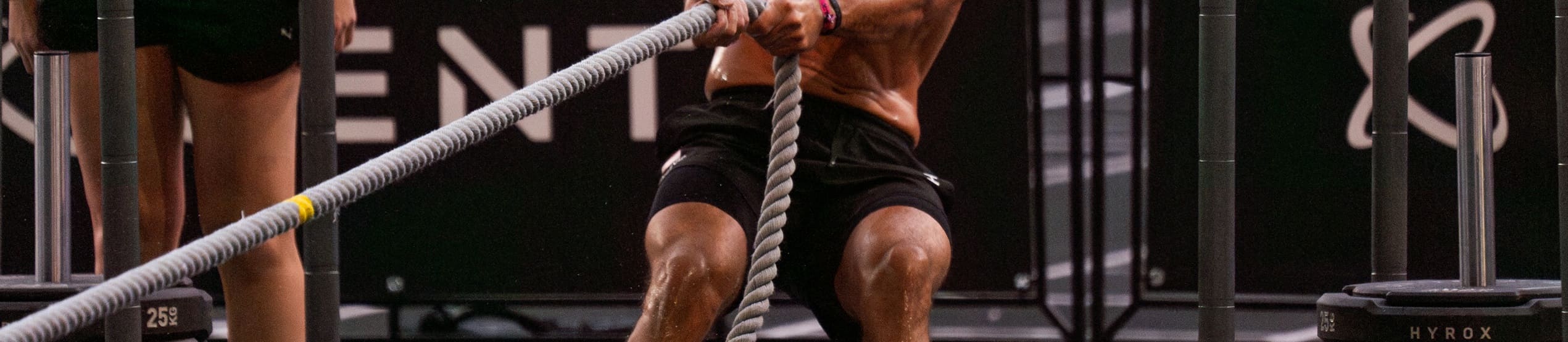
The Sled Pull requires strong leg, back, and core muscles, and depending on the technique chosen, the arm muscles (biceps and forearms) can also be heavily taxed. Sled pulling is therefore a high-intensity full-body exercise, which should also be reflected in your training. In addition, the Sled Pull is one of the more technically demanding exercises in Hyrox: You must make sure to always remain within the marked zone, as (repeatedly) stepping out will result in painful distance and time penalties. Effective rope management is of paramount importance here, so that the rope does not take up valuable space in the already narrow and short pulling zone. In addition, almost every Hyrox race sees several falls, as athletes slip on the rope or trip over it; athletes also repeatedly lose their shoes because they get caught in the rope or unfortunately get snagged.
So, in addition to the conditioning requirements, many details of the movement sequence must be observed, which should definitely be taken into account in Hyrox training.
Just like with the Sled Push, the gliding properties of the sled or carpet are an unpredictable factor again and again, so you had better prepare for a tough fight and train accordingly!
⚠️ Important: If the sled demands an enormous amount from you, you will naturally lose valuable time. On the other hand, the Sled Pull can also cost you an enormous amount of energy due to the high full-body demand, so you may no longer be able to deliver your usual performance for the rest of the race. So make sure that you develop an effective technique and solid strength reserves in training so that you are prepared for the "worst case" here too!
The characteristic of being a key discipline is also evident in the wide spread of race times: The field of athletes separates even more clearly than with the Sled Push, and after the pull, clear trends for the further course of the race can be seen for the first time. For example, the analysis of the past Hyrox World Championships shows that very strong individual athletes complete the Sled Pull (with Pro weight) in just over 3 min, the average is around 5.5 min, and quite a few participants need 7-10 min or more.
So you can see that the Sled Pull is a demanding discipline, but with the right preparation and tactics you can also gain a major advantage and position yourself comfortably for the rest of your race!
Sled Pull Technique
You can see the correct execution and tips on technique, training, and tactics here in the Video by the first Hyrox World Champion Lukas Storath aka Luke.Fit.
Although there are a variety of ways to pull the sled, one technique has established itself among the vast majority of athletes:
“Walk Back”: You grip the rope with outstretched arms and walk backward to the end of the zone, before you quickly throw the rope to the side or backward, set it down or push it away with your foot, quickly come back forward, and set up for the next pull. Depending on personal preference, some athletes hold the rope during the recovery phase, while others set it down. Make maximum use of the zone here, without stepping out and thus risking a penalty. Make sure that the sled completely crosses the line on the last pull. Work quickly overall, but focused and controlled; unnecessary rushing increases the risk of mistakes and drives your heart rate up.
A special feature of the Sled Pull, which can also influence the technique: The closer the sled gets, the easier the pull becomes, as significantly less energy is lost in the slightly elastic rope. This can make it particularly sensible for heavy and very strong athletes to complete the last 2-4 m standing up with an explosive hip extension and simultaneous arm pull ("High Pull") or even purely from the arms ("Hand over Hand"). However, this is the exception and should only be considered in the Double or if you are very strong in your upper body and it is generally easy for you to move the sled.

As mentioned, effective rope management is particularly crucial: Make sure to set the rope aside or backward on every pull so that it does not get in your way (and does not end up on the side track). Alternatively, you can also push it backward with your foot while walking back, but this is somewhat slower and increases the risk of tripping, which is why we advise against it. Test in training with timed trials which variation you manage best and continue to optimize the movement sequences. Especially with the Sled Pull, you can gain a decisive advantage with an efficient technique!
Training for Sled Push
All the points we already discussed in the Sled Push article also apply to the Sled Pull.
The Sled Pull is a central discipline and should be prioritized accordingly in training. The training should be adapted depending on the training phase.
Off-Season
In the off-season, it is recommended to build a strong foundation with heavy weights while maintaining the highest possible movement speed and long breaks. This allows you to achieve a specific strength surplus that enables you to easily handle the competition weight in the later training cycle even after pre-fatigue.
💪 Pro Tip: Also integrate the Sled Pull with light weight and high volume into your base training! One possible session could consist of alternating 5 - 10 minutes of running or ergometer with 5–10 minutes of continuous Sled Pull for a total duration of 40–80 minutes. Pay attention to efficient technique and light to moderate weight. You should by no means overtax yourself here, but rather work calmly and consistently. This will help you build a solid conditioning foundation and perfect your movement sequences more and more.
Pre-Season
In the pre-season (about 8 to 4 weeks before your competition), the Sled Pull should be optimized by repeatedly training with heavy weight over the competition distance and including the transfer into the run. Analogous to the Sled Push, you can, for example, complete 4-5 lanes of pulling and switch directly into a brisk run (min. competition pace) of 200 - 500 m. Due to the high overall load, 3-4 sets at high intensity are sufficient here.
In-Season
In the immediate competition preparation (in-season), you benefit from your built-up sled-specific foundation in strength, endurance, and speed. Now the primary goal is to be able to deliver your Sled Pull performance even when fatigued and after pre-fatigue and perform so efficiently that you can immediately start running briskly afterwards and handle the high overall load of the two sled stations well. Classic Hyrox workouts in interval style are ideal here, e.g., 6 rounds of 300 m of intensive rowing, 4 lanes of push-pull (with pull competition weight) and 500 m of running with a 90 sec round break. During this, you should be able to complete each round (almost) in the same time, so pay attention to your pacing!
⚠️ Important: It cannot be emphasized enough that the "competition weight" is based on the perceived level of exertion and that the Hyrox carpet is known to glide poorly. Every race and every sled within a Hyrox event can be different. Factors such as the wear and tear of the carpet and sled, unevenness in the gym floor, humidity, and wrinkling in the carpet significantly influence the level of exertion! This is not in your hands, but you can and should prepare for the "worst-case scenario" to be prepared for all eventualities. Therefore, if in doubt, always train with more weight than specified in the competition and occasionally practice with different combinations of sled and surface (e.g., pushing on rubber flooring or asphalt, guest training in foreign gyms with different equipment, etc.).
Keep your sled training uncomplicated and repeatedly use proven sled workouts. Build up solid basic strength and endurance and become increasingly specific towards the competition. Ideally, you should have both push and pull on the plan about 1 – 2 times per week, depending on the training phase and individual strengths/weaknesses. Especially with sled pulling, effective technique is essential, so place a high value on execution in every training session. Our tip: Stop your times and occasionally record yourself on video to check your progress on the one hand and analyze your technique under time pressure on the other.
This is how you gain a decisive advantage in these two often feared disciplines and an excellent starting position for the rest of your Hyrox race!
Alternative and Supplementary Exercises
A common problem is the availability of the corresponding equipment: A sled can be found in more and more gyms, but it is still far from being standard equipment. Especially with the Sled Pull, you should train regularly on the sled or at least with a very close exercise alternative due to the technical component to get the best results.
So you can pull one or more weight plates on a suitable floor surface (rubber). Alternatively, you can use a wooden pallet loaded with weight as a sled alternative in a large parking lot. Regardless of whether with a sled or substitute tool: Make sure to use a long rope (if possible 15 m or longer) to realistically train the competition distance of 4 x 12.5 m. As explained, the pull becomes easier the closer the weight is. If you always train with a very short rope, you may be surprised how difficult it is to get the sled moving in the competition.
💡 Tip: If you are a Hyrox beginner and have no way to simulate the Sled Pull in your gym, you can, for example, occasionally get a day pass at a fully equipped studio or Crossfit box. Even a one-time (ideally professionally guided) sled training will advance you at the beginning and give you the necessary confidence for your first Hyrox race.
In addition, there is a series of supplementary exercises that make the Sled Pull significantly easier for you. A strong grip and pulling strength are just as important as powerful legs and a stable core. Rely on proven strength basics here: Deadlifts (with barbell, kettlebells, or dumbbells), rows of all kinds (especially bent-over rows, inverted rows on the rope or rings, and heavy seated cable rows have an excellent transfer) and demanding stability exercises with a focus on anti-rotation like X-Planks and Renegade Rows.
The more powerful your initial strength impulse is set, the faster and easier you can get the sled moving. You lead this first pull with an explosive hip extension; exercises like heavy kettlebell swings and power cleans support this optimally.
💡 Need to know: The load on the legs is often underestimated. Especially after the exhausting combination of Sled Push-Run, the musculature of the front of the thigh (quadriceps) can quite possibly be the limiting factor of your Sled Pull performance. Here you increase your strength and strength endurance with the same exercises as with the Sled Push (and of course many other Hyrox exercises), which is why various squat variations and unilateral exercises should be in every training plan anyway.
💪 Pro Tip: Analyze your personal strengths and weaknesses for each discipline and find out which factors limit your overall performance. If you are already very strong in the squat and deadlift, but your legs quickly become over-acidified on the sled, you should focus on strength endurance training in the HIIT style; on the other hand, if you have an endurance background and generally struggle to move the sled, you will make quick progress with heavy strength training (specifically on the sled and generally with supplementary exercises). Perhaps the Sled Pull does not particularly strain you at all, but you are still not satisfied with your time? Then a training focus on technique and speed or explosive power can bring the greatest benefit.
Tactics in the Hyrox Competition
While the Sled Pull technique is quite demanding and contains some pitfalls, the tactics in the competition are relatively uniform. Due to the alternation of the pulling phase with walking back and the subsequent recovery phase, the rhythm is largely predetermined. Nevertheless, there are some details to observe: Always work quickly and at the same time calmly and focused, especially with the Sled Pull, small and large mistakes can quickly happen unnoticed. If you do not use the zone ideally, you give away valuable centimeters and seconds with every pull, which can quickly add up to a minute or more in the end. Conversely, an inattentive step out quickly costs a bitter time or distance penalty.
You should definitely know your pace, which allows you to pull the sled consistently without major breaks and yet switch directly and quickly into the subsequent run. If you are a very strong athlete, you can, as already mentioned, also complete the last meters standing up with the "Hand over Hand" or "High Pull" technique (powerful hip extension with simultaneous arm pull). This is faster with an explosive execution, but also more exhausting than the "Walk Back", so you should definitely have tested these variants in training and only consider them as an advanced athlete!
As with most Hyrox disciplines, it is important to always keep the exhaustion under control. So take another breath if in doubt and do not get into a rush. With the right technique and a clear head, you will complete the Sled Pull without problems and quickly: Slow is smooth and smooth is fast!
Sled Pull in the Hyrox Double
In the Double, the right tactics and division play a significant role, and it may make sense to resort to more energy-consuming but faster techniques (see above). Here it is important that your partner and you know your strengths and weaknesses and try out different variants in training with timed trials.
If both Double partners are equally strong, a switch after every lane is a proven method, whereby the stronger runner should complete the last lane. Likewise, switches can be made more frequently, as the switch with the right coordination does not take much time. As always, good coordination and communication are crucial here, so definitely train the switches beforehand.
If there is a significant strength imbalance between the partners, we recommend the following strategy: The weaker athlete (in the sled pull) starts with 2–3 clean, long pulls using the "walk-back" technique, which, when performed correctly, covers approximately 1/3 to 1/2 of the track. The stronger partner then takes over and pulls quickly and explosively using the arms (hand-over-hand) or the hips (high pull). You should test during training to see whether a variation in technique is right for you and your partner. If you want to play it safe, stick with the low-impact "walk-back" variation.
The technique you choose will also affect your training, as the accessory exercises should be adapted in addition to the sled pull workout itself. For example, if you use the hand-over-hand technique, all types of horizontal and unilateral pulls (e.g., ring rows, croc rows, seated cable rows, Pendlay rows, etc.) should be a regular part of your training plan. For the high pull technique, all exercises involving particularly powerful or explosive hip extension transfer exceptionally well. Power cleans, kettlebell swings, dumbbell snatches, and deadlifts, among others, will give you the necessary "punch" to move the sled with ease!
Conclusion
The sled pull is one of the key individual disciplines in Hyrox, which often poses problems for beginners but has also decided or pre-decided many races at the professional level. Due to the high demands on technique and strength, it should be given appropriate importance in training. But don't worry—with our tips and the right preparation, you will master the sled pull!

