







Short answer: Breakfast is worth it for everyone. Because if you skip meals, you limit your nutrient intake throughout the day.
No matter what your fitness goal is and no matter when you have your first meal – whether at 9 or 11 a.m. – it should contain enough protein, complex carbs, healthy fats and vitamins. All of this is provided to you in a particularly delicious & incredibly simple way by the 👉 Ultimate Breakfast. Discover now.
Everything a good breakfast needs
Secure it now at a better price
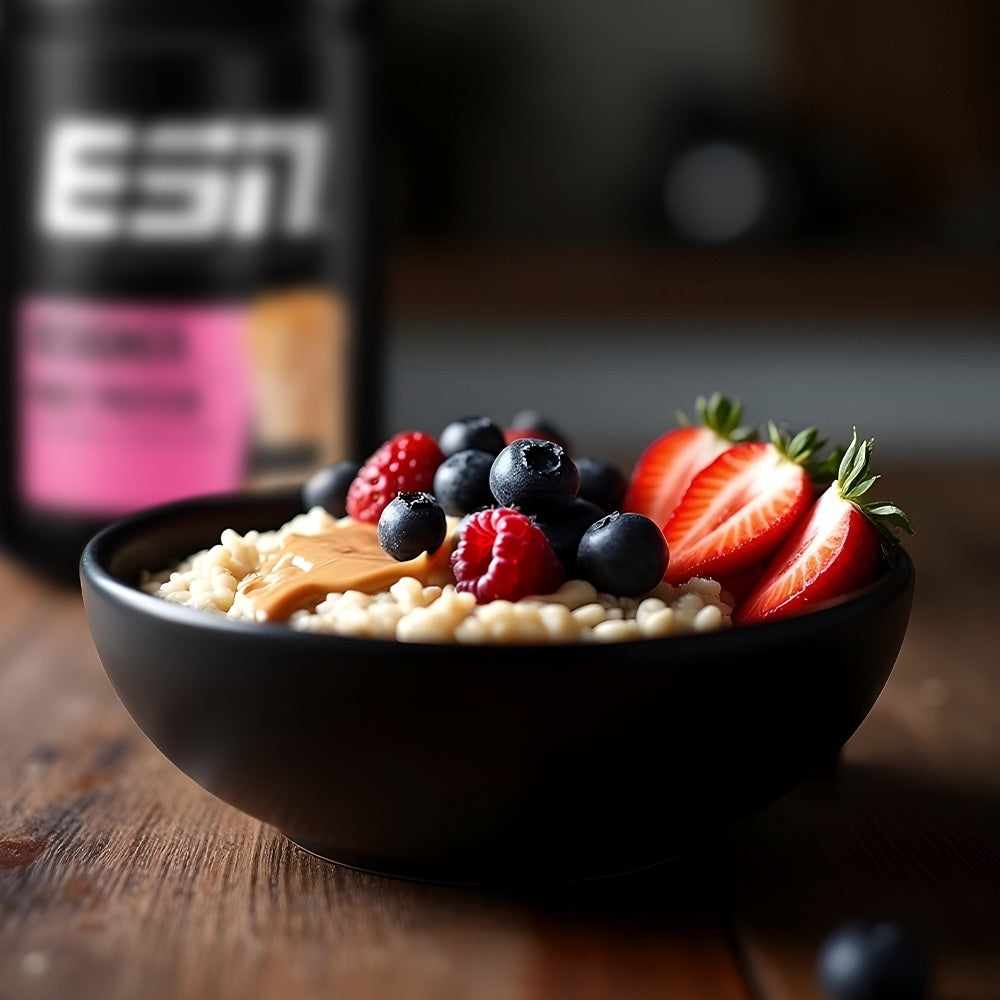
- Pour boiling water over one part Rice Pudding with three parts water, stir and let it sit for 3 minutes.
- Add 30–50 g of Designer Whey as needed and season to taste with Designer Flavor Powder – stir well.
- Now for the toppings: Nut butter for good fats and taste and frozen berries for your vitamin intake. Done!
Tip: You can also easily prepare your ultimate breakfast as a vegan meal with the Vegan Designer Protein — it will have even more volume and become even creamier.

What actually happens
Skipping breakfast does not automatically increase fat burning.
While insulin levels drop during fasting and the body relies more on fatty acids for energy – the daily or weekly fat loss still depends solely on the overall energy balance, i.e., whether you burn more calories than you consume over time.
Fasting can slightly increase fat oxidation in the short term, but as soon as you eat later, this balances out metabolically. Studies show: Over 24 hours, the difference in fat loss between fasters and non-fasters is minimal to non-existent.
When you need to get out the door faster in the morning
Your Breakfast Quick Fixes
Breakfast: Why it makes sense for you
💪 1. Muscle building starts with the first meal
After a night's sleep, amino acid stores are depleted – the body needs a replenishment to enter an anabolic state.
Protein in the morning activates muscle protein synthesis (MPS) and gets the building process started early.
Those who distribute their daily protein intake evenly achieve greater gains in muscle mass, as proven.
🔋 2. More energy & better recovery throughout the day
A balanced breakfast stabilizes blood sugar and supplies the muscles, brain, and nervous system with energy. This reduces fatigue, increases concentration, and ensures more even recovery throughout the day. Strength athletes benefit from the body not remaining in a fasted state for too long – especially during intensive bulking or strength phases.
🧠 3. Hormonal balance & focus
Early energy and protein intake helps to avoid cortisol spikes and keep testosterone levels stable – two factors directly related to muscle building, recovery, and overall readiness to perform.
🧩 Conclusion
Anyone who wants to optimize their performance in the long term benefits from not starting the day on an empty stomach.
Get the ultimate breakfast
Secure up to 35% off now
(32 products)
* -20% off everything, excluding Basic Whey & Performance Whey. Plus: volume discount on Designer Flavor Powder, Rice Pudding, Rice Crispies, pancake & waffle Mix (1=20%, 2=25%, 3=30%, 5=35%).
Betts JA et al., BMJ (2019): Breakfast skipping, metabolism, and energy balance — no consistent effect on daily energy expenditure.
Longo VD & Panda S, Cell Metabolism (2016): Fasting and time-restricted feeding effects on metabolism.
Schoenfeld BJ et al., Journal of the International Society of Sports Nutrition (2015): Influence of meal frequency on body composition.
Areta J.L. et al. (2013). J. Nutr. 143(4): 579–586.
Morton R.W. et al. (2018). Br. J. Sports Med. 52(6): 376–384.
Trommelen J., van Loon L.J.C. (2016). Nutrients 8(12): 763.
van Proeyen K. et al. (2010). J. Physiol. 588(21): 4289–4302.
Gwin J.A. et al. (2020). Nutrients 12(1): 247.
